On the link between environmental health & public health; Rebuilding Haiti from the soil microbes up; A humanitarian aid petri dish; Jared Diamond’s checklist for collapse & Haiti as vision what could be in store for the rest of us; Charcoal cartels, Amy Smith’s better answer & Nicholas Kristof’s compost toilet tour
Five years ago, in a move as practical as it was visionary, the Hôpital Albert Schweitzer (HAS) in Haiti began planting trees – lots of trees – in an effort to mend an ailing landscape.
Small farm plots on hilly terrain had been stripped bare of soil-stabilizing cover (2/3 of the the country is on land that slopes 20% or more). No soil means no food means malnutrition means disease, illness, death.
“Practically every medical problem in Haiti is poverty-related,” notes Dr. Vehnita Suresh, the hospital’s CEO. “The never-ending cycle of deforestation lead(s) to more ecological damage, more compromised farming, more poverty and more hunger. It goes on and on and on.”
Public health and environmental health are so tied together, you simply can’t have the former without the latter. “We can go on giving health-care forever,” says Dr. Suresh, “It would never really touch even the brim of the problem here.”
Small farm plots on hilly terrain had been stripped bare of soil-stabilizing cover (2/3 of the the country is on land that slopes 20% or more). No soil means no food means malnutrition means disease, illness, death.
“Practically every medical problem in Haiti is poverty-related,” notes Dr. Vehnita Suresh, the hospital’s CEO. “The never-ending cycle of deforestation lead(s) to more ecological damage, more compromised farming, more poverty and more hunger. It goes on and on and on.”
Public health and environmental health are so tied together, you simply can’t have the former without the latter. “We can go on giving health-care forever,” says Dr. Suresh, “It would never really touch even the brim of the problem here.”
So they plant trees. The Haiti Timber Re-Introduction Project (HTRIP) has begun to reverse centuries of devastation that literally skinned the country alive, leaving hillsides such as the ones surrounding the Artibonite Valley where the hospital is located barren and bleak.
 |
In the aftermath of the earthquake, reforestation has taken a back seat to the urgency of treating the injured (you can donate directly to support the hospital’s work). But over the long term, any real “Hope for Haiti” means planting trees – literally rebuilding the country from its soil microbes up.
AVOIDING COLLAPSE: LAB HAITI
Haiti has been teetering at brink of breakdown for as long as anyone can remember, but it took the quake to focus global attention, sparking an unprecedented outpouring of support and a largely spontaneous explosion of technical can-do innovation. FromCrisisMappers and Crisis Commons hackers to the collaborative Haiti Rewirednetwork, Twitter hashtag-enabled mash-ups and teams of volunteer architects, engineers, doctors, veterinarians and other professionals, this has been an all-hands-on-deck emergency.
In a sense, Haiti has become a sort of petri dish for humanitarian action. The stakes couldn’t be higher. If, somehow, this “Exhibit A” for all that Jared Diamond says spells doom for a culture/country’s prospects is rescued from the abyss of complete collapse, the implications go far beyond Haiti.
Haiti, in all its deforested, polluted, cartel-corrupted, disease-riddled impoverishment, is a vision of our planet’s future if we continue to devour natural resources beyond replenishment, downplay the seriousness of climate change, spike efforts at family planning and ignore the integral importance of environmental health. As goes Haiti, so go we all.
“The most important thing we need to do about the world’s environmental problems,” says Diamond, “is trying to forget about there being any most important thing we need to do. Instead, there are dozen things and we’ve got to get them all right.”
EDEN WRECKED
Haiti has been teetering at brink of breakdown for as long as anyone can remember, but it took the quake to focus global attention, sparking an unprecedented outpouring of support and a largely spontaneous explosion of technical can-do innovation. FromCrisisMappers and Crisis Commons hackers to the collaborative Haiti Rewirednetwork, Twitter hashtag-enabled mash-ups and teams of volunteer architects, engineers, doctors, veterinarians and other professionals, this has been an all-hands-on-deck emergency.
In a sense, Haiti has become a sort of petri dish for humanitarian action. The stakes couldn’t be higher. If, somehow, this “Exhibit A” for all that Jared Diamond says spells doom for a culture/country’s prospects is rescued from the abyss of complete collapse, the implications go far beyond Haiti.
Haiti, in all its deforested, polluted, cartel-corrupted, disease-riddled impoverishment, is a vision of our planet’s future if we continue to devour natural resources beyond replenishment, downplay the seriousness of climate change, spike efforts at family planning and ignore the integral importance of environmental health. As goes Haiti, so go we all.
“The most important thing we need to do about the world’s environmental problems,” says Diamond, “is trying to forget about there being any most important thing we need to do. Instead, there are dozen things and we’ve got to get them all right.”
EDEN WRECKED
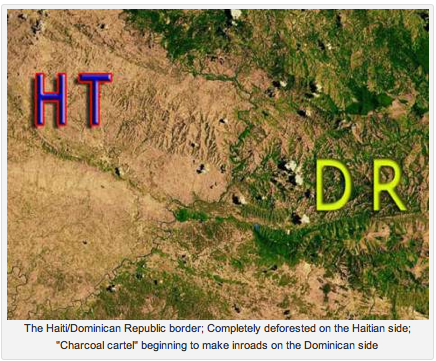 |
Where did all the forests go? The stats are as numbing as the satellite photos are stark:
LOW TECH / LOW COST: SOLUTIONS IN PROBLEMS
In a twist of dust-to-dust poetry, some of the answers to Haiti’s most intractable problems can be found in the one thing that Haiti has in abundance: waste.
About 10 years ago, MIT D-Lab founder Amy Smith, took a group of students to Haiti, where they were inspired by a local entrepreneur who had developed a way to make charcoal briquettes from scrap paper. Smith’s team improved the process, using agricultural waste as feedstock. In 2006, she presented the results at the TED conference.
- 1492: Columbus stops by. 75% of what would become Haiti covered in trees
- 1664: The French West India Company formed. Millions of trees chopped & harvested to create massive plantations. African slaves by the tens of thousands are imported to provide labor.
- 1825: French agree to recognize Haiti’s freedom, won in 1804, in exchange for 150 million francs (later reduced to 90 million). This puts the country in deep debt from which it never recovers. Much of the country’s timber wealth (mahogony) ships out for a song.
- 1940: An estimated 30% of country still forested
- 1970: Only 10% forested. People depend on charcoal made from wood for cooking. By contrast, government subsidizes gas stoves in the Dominican Republic
- 2010: Less than 1% forested. “Charcoal cartels” start chopping down trees across the Dominican border. Eroded land silts up lake, floods key road to Port-au-Prince. $40 million need to build alternate road.
LOW TECH / LOW COST: SOLUTIONS IN PROBLEMS
In a twist of dust-to-dust poetry, some of the answers to Haiti’s most intractable problems can be found in the one thing that Haiti has in abundance: waste.
About 10 years ago, MIT D-Lab founder Amy Smith, took a group of students to Haiti, where they were inspired by a local entrepreneur who had developed a way to make charcoal briquettes from scrap paper. Smith’s team improved the process, using agricultural waste as feedstock. In 2006, she presented the results at the TED conference.
| |
The upsides are stunning: No trees cut. A better product. Makes money for the producers. And since charcoal generates less smoke than wood, fewer cases of cooking fire smoke-induced acute respiratory illness, the leading cause of death for those under 5 years old in developing countries.
The process continues to be improved. Here is a step-by-step DIY field demo by Smith:
The process continues to be improved. Here is a step-by-step DIY field demo by Smith:
| |
SHIT HAPPENS – THAT’S GOOD NEWS
SOIL, a small American non-profit operating in Haiti, has a plan for turning one of the country’s foulest, most intractable public health issues into a plus: transforming smelly poop into fragrant fertile compost. “Instead of potting soil, potty soil.”
Composting toilets themselves are nothing new, but developing a sustainable community-supported model for their use is – and key to the group’s over-arching mission to reduce poverty via “liberation ecology.” With the likes of Partners in Health co-founder Paul Farmer and The Land Institute’s Wes Jackson on their all-star advisory board, they have a better shot than most at getting the plan to work.
In March, 2009, the New York Times’ Nicholas Kristof took a tour with SOIL staffers Sasha Kramer and Sarah Brownell:
SOIL, a small American non-profit operating in Haiti, has a plan for turning one of the country’s foulest, most intractable public health issues into a plus: transforming smelly poop into fragrant fertile compost. “Instead of potting soil, potty soil.”
Composting toilets themselves are nothing new, but developing a sustainable community-supported model for their use is – and key to the group’s over-arching mission to reduce poverty via “liberation ecology.” With the likes of Partners in Health co-founder Paul Farmer and The Land Institute’s Wes Jackson on their all-star advisory board, they have a better shot than most at getting the plan to work.
In March, 2009, the New York Times’ Nicholas Kristof took a tour with SOIL staffers Sasha Kramer and Sarah Brownell:
| |
SOIL’s approach parallels MacArthur genius Will Allen‘s vermiculture-based urban farms. The flagship 3-acre Growing Power farm, located just a few blocks from Milwaukee’s largest public housing project, is a stunning example of ecosystem-thinking applied to intensive agriculture. And it all begins with worms chowing down on municipal waste, turning garbage into fertile black gold. Allen also weaves in aquaponics – a freshwater closed loop fish-operation (perch, tilapia). Plants are nourished by fish-poo water, which filters down back to the fish. Could such a system work in Haiti? It certainly seems worth investigating.
HIGH TECH HELP
Tree-planting, briquettes, compost toilets and urban farming don’t require a lot of complicated moving parts or all that much money. Their simplicity is an essential part of why they might make a real difference. But high tech tools can help make these good ideas even more effective.
HIGH TECH HELP
Tree-planting, briquettes, compost toilets and urban farming don’t require a lot of complicated moving parts or all that much money. Their simplicity is an essential part of why they might make a real difference. But high tech tools can help make these good ideas even more effective.
- Mapping: Tools to track and predict deforestation, including illegal logging, and to help identify good sites for reforestation projects.
- Communications: Connecting charcoal briquette producers with ag waste sources and with customers; Web-based how-to guides on how to make charcoal briquettes, tree-care tips, etc.
- Fundraising: M-giving and other philanthropy tools, e.g., develop a game where players grow a cyber-forest – download proceeds to support a real forest.
RELATED
- “After the earthquake: Haiti’s deforestation needs attention” by Moises Velasquez-Manoff (Christian Science Monitor)
- “Agroforestry and sustainable resource conservation in Haiti: A Case Study” by Nathan McClintock
- U.S. Senate Bill 1183: Haiti Reforestation Act of 2009 introduced by Senator Dick Durbin
- “Haiti and the Dominican Republic: One Island, Two Worlds” by Jared Diamond (excerpt from “Collapse”)
- “Collapse: How Societies Choose to Fail or Succeed” by Jared Diamond (book)
- “Jared Diamond on why societies collapse” (TED talk – video)
- The Charcoal Project (website)
- Growing Power (website)
- “The Farm Next Door: Urban Agriculture, Biomimicry, Aquaponics, Why Worms are Priceless & How Will Allen Aims to Fix the World” by J.A. Ginsburg (Trackerblog)
- “Google Earth boosts deforestation monitoring capabilities” by Rhett A. Butler (Mongabay.com)