
Hope Phones is one of those “Gosh, yes!” ideas:
- Get people to donate old cell phones to a recycling company
- Get recycling company to assign each phone a value
- Use value to trade for refurbished phones
- Donate refurbished phones to clinics in developing countries to use for sending health-related text messages
- Good begets good
Phones were given to a group of volunteer community health workers who support the hospital’s two (count’em two) staff doctors, traveling dozens of miles by motorbike and on foot each day to meet patients. It was the first time some of them they had ever used a phone. $500 was allocated as the annual budget for messages (10 cents per = 5,000).
The wins were immediate and sizable. In the first six months, the hospital saved $3,000 in motorbike fuel, shaved off 3,500 hours in staff travel time, while doubling the number of TB patients served. Nesbit, pumped by such a simple triumph of tech-for-the-greater good, now wants to scale up the project and duplicate it Bangladesh, Burundi, Honduras, Uganda, Lesotho and additional clinics in Malawi. Which means phones. Lots of phones.
But Hope Phones may prove to be an even better idea than he realizes.
MOBILE PILE-UP
As amazing and essential as cell phones have become, their disposal is a logistical and hazmat nightmare. Even in a down economy, well over a billion cell phones and smartphones are sold each year. According to the EPA, between 100 million and 130 million discarded phones are sitting in drawers in the U.S., mostly because people don’t know what to do with them. (Some estimates peg the annual number “retired” handsets at 155 million, which translates 426,000 per day. Taking current recycling numbers into account, then rolling over the surplus from year to year, the number of stashed phones can probably be measured in the hundreds of millions.)
If nothing else, it is a giant waste of energy. According ot the EPA:
The wins were immediate and sizable. In the first six months, the hospital saved $3,000 in motorbike fuel, shaved off 3,500 hours in staff travel time, while doubling the number of TB patients served. Nesbit, pumped by such a simple triumph of tech-for-the-greater good, now wants to scale up the project and duplicate it Bangladesh, Burundi, Honduras, Uganda, Lesotho and additional clinics in Malawi. Which means phones. Lots of phones.
But Hope Phones may prove to be an even better idea than he realizes.
MOBILE PILE-UP
As amazing and essential as cell phones have become, their disposal is a logistical and hazmat nightmare. Even in a down economy, well over a billion cell phones and smartphones are sold each year. According to the EPA, between 100 million and 130 million discarded phones are sitting in drawers in the U.S., mostly because people don’t know what to do with them. (Some estimates peg the annual number “retired” handsets at 155 million, which translates 426,000 per day. Taking current recycling numbers into account, then rolling over the surplus from year to year, the number of stashed phones can probably be measured in the hundreds of millions.)
If nothing else, it is a giant waste of energy. According ot the EPA:
If Americans recycled 100 million phones, we could save enough upstream energy to power more than 194,000 U.S. households for a year. If consumers were able to reuse those 100 million cell phones, the environmental savings would be even greater, saving enough energy to power more than 370,000 U.S. homes each year.
Most Americans, of course, want the upgrade, not last year’s model. The average life expectancy of a phone in the U.S. is a fleeting 18 months. Still, they are more than good enough for sending basic SMS messages, so it’s a matter of getting them to where they’re needed and wanted.
| |
PHONE LOBOTOMIES
Probably the single biggest hurdle keeping donation numbers hovering at an uninspiring 20% is the fear of identity theft. Stories of sensitive, embarrassing and occasionally downright dangerous information turning up on a refurbished phones are not, alas, the stuff of urban legend. A recent survey by a recycler found that a gobsmacking 99% of the phones sampled still had prior owner data – and the “smarter” the phone, the more kinds of data are stored.
If you aren’t terribly techy and can’t bear the detailed torture of user manuals, take your phone to a retailer and ask for some help removing the memory/SIM card and resetting. Then donate.
THERE’S GOLD IN THEM THAR PHONES…
Along with silver, palladium, copper and tin. There isn’t very much of anything in a single phone, but there are so darn many phones, it adds up. A ton of ore from a gold mine typically yields only 5 or 10 grams of gold, but a ton of cell phones (~10,0000) can produce 300 to 400 grams. For the last several months, Sony Corporation has been testing out a recycling program in Kitakyushu, Japan to extract high quality metals from mountains of electronic waste dubbed “urban mines.” 4,400 pounds of raw electronic “ore” (all kinds of electronics, not just cell phones) yielded 39 grams of gold, 164 grams of silver, 73 kilograms of copper and 8 grams of palladium. Unfortunately, unless the labor-intensive extraction process can be improved five-fold, it doesn’t pay.
Yet anything that keeps phones – and their toxic batteries – out of landfills is a plus.Both are full of chemicals known to leach into groundwater. In a few states it is illegal to toss a cell phone.
Probably the single biggest hurdle keeping donation numbers hovering at an uninspiring 20% is the fear of identity theft. Stories of sensitive, embarrassing and occasionally downright dangerous information turning up on a refurbished phones are not, alas, the stuff of urban legend. A recent survey by a recycler found that a gobsmacking 99% of the phones sampled still had prior owner data – and the “smarter” the phone, the more kinds of data are stored.
If you aren’t terribly techy and can’t bear the detailed torture of user manuals, take your phone to a retailer and ask for some help removing the memory/SIM card and resetting. Then donate.
THERE’S GOLD IN THEM THAR PHONES…
Along with silver, palladium, copper and tin. There isn’t very much of anything in a single phone, but there are so darn many phones, it adds up. A ton of ore from a gold mine typically yields only 5 or 10 grams of gold, but a ton of cell phones (~10,0000) can produce 300 to 400 grams. For the last several months, Sony Corporation has been testing out a recycling program in Kitakyushu, Japan to extract high quality metals from mountains of electronic waste dubbed “urban mines.” 4,400 pounds of raw electronic “ore” (all kinds of electronics, not just cell phones) yielded 39 grams of gold, 164 grams of silver, 73 kilograms of copper and 8 grams of palladium. Unfortunately, unless the labor-intensive extraction process can be improved five-fold, it doesn’t pay.
Yet anything that keeps phones – and their toxic batteries – out of landfills is a plus.Both are full of chemicals known to leach into groundwater. In a few states it is illegal to toss a cell phone.
HEART OF DARKNESS (ELECTRONICS EDITION)
Getting rid of cell phones turns out to be the easier half of the cradle-to-grave equation. Sourcing some of the metals required to to run a phone – or an MP3 player or any number of electronic miracles – can be ethically treacherous. Cell phones, however, have been singled out as the poster-gadget in a campaign to stop black market mining in the Democratic Republic of Congo, which has helped fuel violence by funneling millions of dollars to warlords while condemning hundreds of thousands to virtual slavery.
Crew after documentary film crew has slogged through the African jungle for the last decade to haul back footage of scenes from Dante’s worst nightmares. In the middle of nowhere, in wilting tropical heat, surrounded by every kind of creature that bites and stings, far from clean water, healthy food or bare-bones medical care, an estimated 700,000 “artisanal miners” (according to USGS figures) hack away at rock, often working deep in airless mines, hoping to strike cassiterite, coltan or wolframite before it literally strikes them. Mine safety isn’t on the agenda and injuries are common. Many of the miners are children. Ore is carried out in sacks that weigh more than the people whose backs they break.
Getting rid of cell phones turns out to be the easier half of the cradle-to-grave equation. Sourcing some of the metals required to to run a phone – or an MP3 player or any number of electronic miracles – can be ethically treacherous. Cell phones, however, have been singled out as the poster-gadget in a campaign to stop black market mining in the Democratic Republic of Congo, which has helped fuel violence by funneling millions of dollars to warlords while condemning hundreds of thousands to virtual slavery.
Crew after documentary film crew has slogged through the African jungle for the last decade to haul back footage of scenes from Dante’s worst nightmares. In the middle of nowhere, in wilting tropical heat, surrounded by every kind of creature that bites and stings, far from clean water, healthy food or bare-bones medical care, an estimated 700,000 “artisanal miners” (according to USGS figures) hack away at rock, often working deep in airless mines, hoping to strike cassiterite, coltan or wolframite before it literally strikes them. Mine safety isn’t on the agenda and injuries are common. Many of the miners are children. Ore is carried out in sacks that weigh more than the people whose backs they break.
| |  |
CONFLICT MINERALS
Cassiterite (a tin ore), coltan (an ore from which tantalum and niobium a.k.a columbium are extracted) and wolframite (a tungsten ore) have been dubbed “conflict minerals” and are the target of an international effort spearheaded by human rights groups to get electronics manufacturers to support an independently verifiable system for tracking supply chains. It’s a hot issue. In just the last few months, the U.N. released a new report, while the Congo Conflict Mineral Act 2009 (S.891) was introduced in the U.S. Congress.
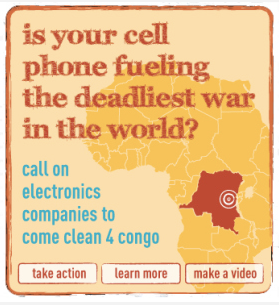
Now a group called“Enough!,” (a project of theCenter for American Progress) has launched“Come Clean 4 Congo,” a campaign to raise awareness via a YouTube-sponsored video contest: “You may not realize it, but you’re cell phone is fueling the deadliest war in the world.”
Well…
Maybe not. Beyond the breathless hyperbolic weirdness of ranking wars by deadliness (do you think the millions of people caught in the cross-hairs and refugee camps of Pakistan, Sri Lanka and Sudan would feel much relief to know that whew! at least they’re not victims of the deadliest war?), it turns out the DRC supplies a very small percentage of the minerals in question.
According to USGS statistics:
Even if the 30% tantalum figure is accurate, it still much lower than an oft-cited statistic that 80% of the world’s coltan comes from eastern Congo. That stat opens a popular documentary produced the Pulitzer Center on Crisis Reporting, which was first broadcast on a program with Newsweek’s Fareed Zakaria.
What gives? How can this massive horror continue if there isn’t all that much money to be made? Why don’t the electronics manufacturers simply declare themselves conflict mineral-free and steer clear of the DRC?
Perhaps part of the answer is that war comes cheap in Congo and lives come even cheaper. The miners work to survive, to barter for food. They have few, if any, other options. Those hauling ore through the jungle are lucky to keep a little profit after paying off rebels and soldiers en route. Smugglers make money from importers willing to turn a blind eye to save customs fees. Guns are easy to come by. Rich is a relative term.
“Enough!” and other humanitarian organizations actually do not want to stop mining in Congo, nor do they want to see foreign companies abandon the country. It is one of the few opportunities for trade and income. Instead, they want supply chain transparency to make it easier to identify, isolate and root out illegal operations. That may be easier said than done. The technology exists to “fingerprint” ore samples and link them to specific mines, but it is a pricey process. Once the ore is refined and mixed with ore from other mines, it is impossible.
Ironically, in the corruption-warped day to day reality, the status quo offers perverse security. In the 2008 French documentary “Blood Coltan,” a middleman dealer filmed via hidden camera justifies his business by noting that miners wouldn’t have any work at all if he weren’t there to buy the minerals. Despite the bone-chilling amoral cynicism, he has a point. It is not enough to call for a halt to the conflict-mineral trade without also providing alternative livelihoods and the safety in which to pursue them.
Even with legal operations, mine working conditions are likely a low priority in the DRC and in other countries such as China where some of these minerals are sourced. Conflict minerals is a first bold volley in the battle for ethical e-sourcing.
Cassiterite (a tin ore), coltan (an ore from which tantalum and niobium a.k.a columbium are extracted) and wolframite (a tungsten ore) have been dubbed “conflict minerals” and are the target of an international effort spearheaded by human rights groups to get electronics manufacturers to support an independently verifiable system for tracking supply chains. It’s a hot issue. In just the last few months, the U.N. released a new report, while the Congo Conflict Mineral Act 2009 (S.891) was introduced in the U.S. Congress.
Now a group called“Enough!,” (a project of theCenter for American Progress) has launched“Come Clean 4 Congo,” a campaign to raise awareness via a YouTube-sponsored video contest: “You may not realize it, but you’re cell phone is fueling the deadliest war in the world.”
Well…
Maybe not. Beyond the breathless hyperbolic weirdness of ranking wars by deadliness (do you think the millions of people caught in the cross-hairs and refugee camps of Pakistan, Sri Lanka and Sudan would feel much relief to know that whew! at least they’re not victims of the deadliest war?), it turns out the DRC supplies a very small percentage of the minerals in question.
According to USGS statistics:
- Australia, Brazil and Canada supply the lion’s share of the world’s tantalumand niobium (aka columbium), which are the minerals extracted from coltan. Congo’s contribution is so small, it is lumped with “other countries” at the bottom of the “World Mine Production, Reserves, and Reserve Base” lists. (However, according to “Enough!,” the figure may be as high as 30% due to a halt in Australian production)
- Congo is lumped with “other countries” for tungsten mining. China dominates the global market with ample reserves.
Even if the 30% tantalum figure is accurate, it still much lower than an oft-cited statistic that 80% of the world’s coltan comes from eastern Congo. That stat opens a popular documentary produced the Pulitzer Center on Crisis Reporting, which was first broadcast on a program with Newsweek’s Fareed Zakaria.
What gives? How can this massive horror continue if there isn’t all that much money to be made? Why don’t the electronics manufacturers simply declare themselves conflict mineral-free and steer clear of the DRC?
Perhaps part of the answer is that war comes cheap in Congo and lives come even cheaper. The miners work to survive, to barter for food. They have few, if any, other options. Those hauling ore through the jungle are lucky to keep a little profit after paying off rebels and soldiers en route. Smugglers make money from importers willing to turn a blind eye to save customs fees. Guns are easy to come by. Rich is a relative term.
“Enough!” and other humanitarian organizations actually do not want to stop mining in Congo, nor do they want to see foreign companies abandon the country. It is one of the few opportunities for trade and income. Instead, they want supply chain transparency to make it easier to identify, isolate and root out illegal operations. That may be easier said than done. The technology exists to “fingerprint” ore samples and link them to specific mines, but it is a pricey process. Once the ore is refined and mixed with ore from other mines, it is impossible.
Ironically, in the corruption-warped day to day reality, the status quo offers perverse security. In the 2008 French documentary “Blood Coltan,” a middleman dealer filmed via hidden camera justifies his business by noting that miners wouldn’t have any work at all if he weren’t there to buy the minerals. Despite the bone-chilling amoral cynicism, he has a point. It is not enough to call for a halt to the conflict-mineral trade without also providing alternative livelihoods and the safety in which to pursue them.
Even with legal operations, mine working conditions are likely a low priority in the DRC and in other countries such as China where some of these minerals are sourced. Conflict minerals is a first bold volley in the battle for ethical e-sourcing.
 |  |
DO THE RIGHT THING
Whether or not my adorable, talented app-happy iPhone—the Swiss Army knife of the 21st century— has blood on its screen, the point is it could.
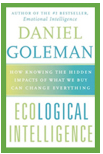
The point, as Daniel Goleman explores in his new book,“Ecological Intelligence,” is that the supply chain of even a simple glass bottle has nearly 2,000 links. Everything has a bit of everywhere.
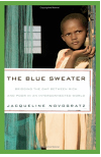
The point, as Jaqueline Novogratz explains in her new book, “The Blue Sweater: Bridging the Gap Between Rich and Poor in an Interconnected World,” is that we are connected in ways we can’t even imagine. (The title refers to a sweater she loved as a girl, outgrew and donated to Goodwill. Years later, she met a boy wearing the very same sweater—name tag and all—on the streets of Kilgali, Rwanda, where she was working on a micro-finance project.) Our actions, as well as our failures to act, have ramifications.
The point is to pay attention and try to do the right thing.
That’s not always such an easy call. Except when it is. Recycle electronics. Donate old cell phones. Help a clinic in a developing country. Make Josh Nesbit’s day.
Whether or not my adorable, talented app-happy iPhone—the Swiss Army knife of the 21st century— has blood on its screen, the point is it could.
The point, as Daniel Goleman explores in his new book,“Ecological Intelligence,” is that the supply chain of even a simple glass bottle has nearly 2,000 links. Everything has a bit of everywhere.
The point, as Jaqueline Novogratz explains in her new book, “The Blue Sweater: Bridging the Gap Between Rich and Poor in an Interconnected World,” is that we are connected in ways we can’t even imagine. (The title refers to a sweater she loved as a girl, outgrew and donated to Goodwill. Years later, she met a boy wearing the very same sweater—name tag and all—on the streets of Kilgali, Rwanda, where she was working on a micro-finance project.) Our actions, as well as our failures to act, have ramifications.
The point is to pay attention and try to do the right thing.
That’s not always such an easy call. Except when it is. Recycle electronics. Donate old cell phones. Help a clinic in a developing country. Make Josh Nesbit’s day.
RELATED
- “Congo Fighting Revives Tainted Phone Fears,” Jack Ewing, BusinessWeek
| |