
CFLs (compact florescent light bulbs) may have become the symbol for greener lighting over the last couple of years, but LEDs — those ubiquitous light emitting diodes on everything from digital alarm clocks to laptops — are poised for a global come-from-behind take-over. The key stumbling point has always been the cost the production. That’s about to change.
LEDs use only a tiny fraction of the energy needed by florescents and can last a decade or longer, but manufacturing complications require the use of sapphire, a rare and expensive material. Now research at the University of Cambridge promises a super-cheap alternative. Once that pesky little problem is solved, CFLs — and their inconveniently un-green mercury residues — will soon go the way of….incandescents.
LEDs use only a tiny fraction of the energy needed by florescents and can last a decade or longer, but manufacturing complications require the use of sapphire, a rare and expensive material. Now research at the University of Cambridge promises a super-cheap alternative. Once that pesky little problem is solved, CFLs — and their inconveniently un-green mercury residues — will soon go the way of….incandescents.
(The EPA’s clean up guidelines for broken CFLs are Hazmat-thorough and energy intensive, which begs the question why anyone living in an earthquake-prone area, or with young children in the house, would want to use them.)
Despite high costs, though, there is strong and growing demand for these energy-miser bulbs both the developing world where the electric grid has yet to reach, and in the developed world where grid-liberation is the goal.
Despite high costs, though, there is strong and growing demand for these energy-miser bulbs both the developing world where the electric grid has yet to reach, and in the developed world where grid-liberation is the goal.
SOURCES & STORIES
Below is a round-up of links that have been featured on the TrackerNews site:
Below is a round-up of links that have been featured on the TrackerNews site:
- Light Up the World Foundation: Started by University of Calgary professor Dave Irvine-Halliday, LUWF has pioneered the installation of LED lighting units in the developing world that are powered by renewable sources (solar, wind, even pedal power). The goal is two-fold: bring light to some of the 2 billion people without electricity and provide an alternative to smokey, dangerous, ineffective kerosene lamps. “The Man Who Lit Up the Mountains” is a short video about LUWF and its first project in Nepal.
- The Lumina Project: This is an extremely rich resource for field research and reference materials — a must-visit site. Be sure to check out their collaborative partners for more good leads (e.g., Lighting Africa). “Solid-State Lighting on a Shoestring Budget: The Economics of Off-Grid Lighting for Small Businesses in Kenya,” published last December, is typical of the thoroughness of their field work. It looks at everything from efficiency to consumer price-point sensitivity (~$15, btw). Even the best technology isn’t worth much if it doesn’t address barriers to adoption.
- d.light: A start-up with momentum, that’s grown from an idea in a social entrepreneurship class at Stanford, to a company with a factory in China and sales offices in India and Tanzania, with an impressive list of investors. They sell two styles of LED lights, both of which can be recharged using solar or AC grid power. The Nova series is a hand-held super duper flashlight, while the Solata is a small, rather stylish table light. As par of their mission, d.lights offers a fellowship program to work in Shenzhen or New Delhi (February 15 is the deadline for 2009 applications; a global photography fellowship has a “rolling application”).
- One Million Lights Foundation: Inspired by a school started by her father in rural India over 40 years ago, Anna Sidana founded OMLF to help improve education in regions of the world where a lack of electricity makes it impossible for children to study at night. These children generally work after school, so study time is precious. Last December, eBay chipped in for 15,000MightyLights, which, like d-light Nova lamps, are industrial strength flashlights that can be recharged with a solar panel. (Sidana’s day job is Director, Financial Products for PayPal, which is owned by eBay.) Here is a video of her presenting the first delivery to her father’s school.
| |
- LEDlights.org Resources page: All kinds of good leads for articles, reviews and products
- Dean Kamen’s North Dumpling Island, aka “The World’s First LED Nation”: In an effort to bring energy needs down to levels supportable by off-grid power generation, Kamen switched to LEDs for the nation’s three buildings and mini-Stonehenge installation. Although the change was pricey, costing tens of thousands of dollars, energy use was halved, even after adding outdoor lighting.
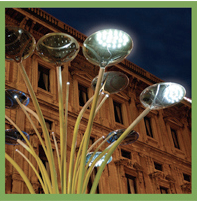 |
- The Solar Tree: This is what happens when a design aesthetic gets added to the equation. Ross Lovegrove, a.k.a. “Captain Organic” (see TED talk) turned street lighting into public gathering place. During the day, the tops of the Solar Tree’s leaves do what real tree leaves do: soak up the sun’s energy. At night, the leaves LED-laced bottom surfaces shed light.
PHYTOPHOTONICS
LEDs aren’t just for humans, either. Plants are partial to them, too, particularly the red and blue ones. Light color affects everything from leaf shape to chemical content to flowering times, so botanists are keen to see if they can use LEDs to manipulate plant development.
A prototype LED greenhouse is being built in Denmark. The expected energy savings are so dramatic, installation costs could be recouped in just three years. Sensors dim or brighten the lights to accomodate passing clouds, keeping plant light intake constant. It is also easier to harvest waste-heat from LEDs than from florescent lights, which can then be used to warm irrigation water.
It a world too full of dark news, LEDs literally are a beacon of light.
LEDs aren’t just for humans, either. Plants are partial to them, too, particularly the red and blue ones. Light color affects everything from leaf shape to chemical content to flowering times, so botanists are keen to see if they can use LEDs to manipulate plant development.
A prototype LED greenhouse is being built in Denmark. The expected energy savings are so dramatic, installation costs could be recouped in just three years. Sensors dim or brighten the lights to accomodate passing clouds, keeping plant light intake constant. It is also easier to harvest waste-heat from LEDs than from florescent lights, which can then be used to warm irrigation water.
It a world too full of dark news, LEDs literally are a beacon of light.